Get some insights and background information about the open think tank about mobile media and communication.
DIGITAL. TRENDS. FUTURE.
14
Sep
Sep
Interview with Lauri Hirvonen, Senior Business Development Manager at NOKIA and founding member of dotMobi. He talks about the history, present and future of dotMobi at the mobileinnovationweek.com in Toronto.
13
Sep
Sep
Dom Sagolla was one of the first emloyees at Twitter and is now publishing a book about the micro-blogging service, called 140 Characters: A Style Guide for the Short Form

Dom writes about the definitive history of Twitter, from an insider’s point of view, about the new grammar rules for short-form writing, and a catalog of writing styles and includes inspiring quotations from comedy to poetry from some of the best writers.
Here is a Video Interview I recorded at the Mobile Innovation Week in Toronto.
11
Sep
Sep
I will be speaking at Mobile Media World 2009 in Toronto next week. The event is part of the Mobile Innovation Week and features a selection of the leading experts in the mobile and telecommunication industry.
I will be speaking about key trends for the next decade of mobile media and will presented my latest publication
Mobile Future @mocom2020: A collaborative vision of the future of Mobile Media and Communication

08
Sep
Sep
 Getting information as fast as possible and on the spot is the trend. So what could be more direct than having information fired directly into the eye?
A new generation of contact lenses built with very small circuits and LEDs promises bionic eyesight. Today — together with his students — Babak A. Parviz, bionanotechnology expert at University of Washington, is already producing devices that have a lens with one wirelessly Radio Frequency powered LED. To turn such a lens into a functional browser, control circuits, communication circuits and miniature antennas will have to be integrated. These lenses will eventually include hundreds of semitransparent LEDs, which will form images in front of the eye: words, charts, imagery enabling the wearers to navigate their surroundings whithout distraction or disorientation. The optoelectronics in the lens may be controlled by a seperate device that relays information to the lens’s control circuit. Another use could be the monitoring of the wearer’s health and biomarkers f.e. cholesterol, sodium, kalium or glucose.
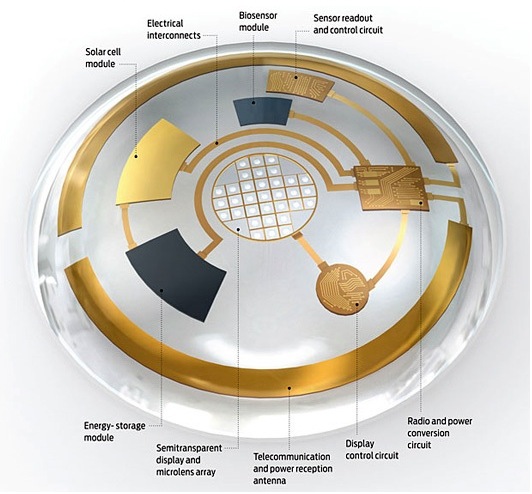
A few barriers have yet to be taken in order to produce such a device. Materials are not compatible with one another; all components have to be assembled onto about 1.5 square centimeters of flexible, transparent polymer; and of course the lens needs to be completely safe for the eye. Parviz mentions that the LED for example is made of aluminum gallium arsenide, a toxic material that should first have to be encapsulated in a biocompatible polymer.
Last but not least: seeing the LED-light switching on and off is one thing, but seeing something comprehensible in dense resolution to the eye is something else.“The true promise of this research is not just the actual system we end up making, whether it’s a display, a biosensor, or both. We already see a future in which the humble contact lens becomes a real platform, like the iPhone is today, with lots of developers contributing their ideas and inventions.”
Contact lenses have always been about improving natural sight, so whatever information they may bring to our eyes in the coming future… may the view be clear.
Via: justgetthere.us
08
Sep
Sep
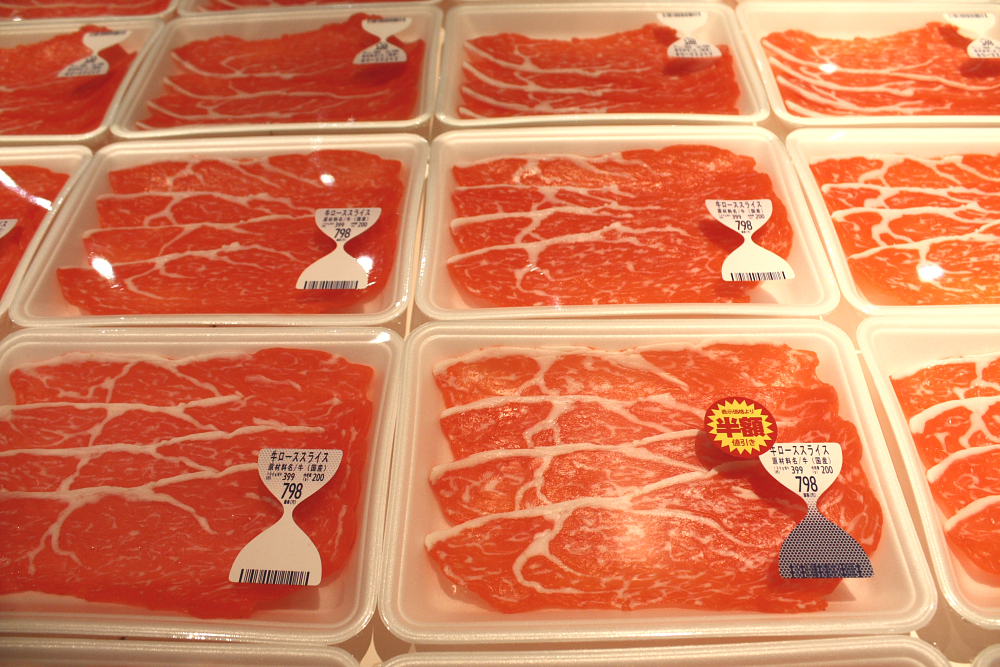 The packaging industry is developing smart new packaging solutions for the retail market. Especially for fresh product a smart label or a digital display integrated within the packaging could show the consumer the freshness and quality of the product. A milk package could show you when it is not a good idea to drink it anymore.
Another example is this hourglass-shaped freshness label for meat products (designed by To-Genkyo). The label contains special ink that changes its color based on the amount of ammonia emitted by the meat (the older the meat, the more ammonia it releases). Like an hourglass, the bottom half of the label “fills up” as the meat ages. Consumers can judge the product’s freshness at a glance.
When the meat is no longer suitable for sale, the ink blocks the barcode at the bottom so that it cannot be scanned at the cash register.
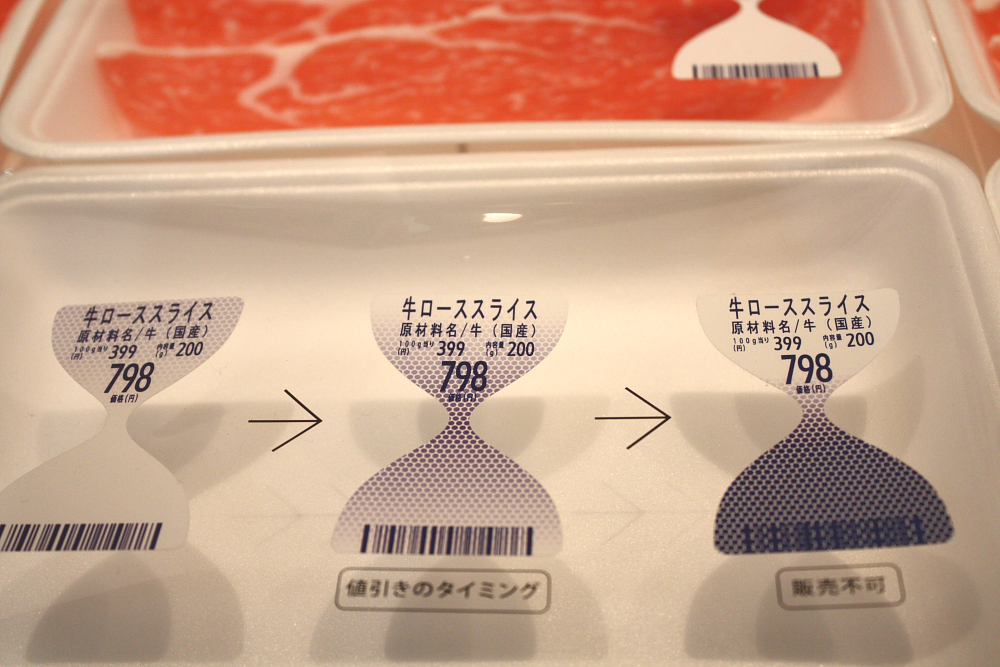
The Freshness Label was presented at the Good Design Expo known as one of the leading design events in Asia. The event showcases thousands of well-designed products under consideration for the year’s Good Design Awards. Over 2,000 items ranging from consumer electronics, automobiles and furniture to office equipment, building designs and sporting goods were exhibited at this year’s event, which was held at Tokyo Big Sight in August 2009.
07
Sep
Sep
We realize Social Media Marketing activities for clients on platforms such as YouTube, facebook, twitter, flickr, Xing etc. I always recommend to start recording and publishing your own videos, e.g. corporate speeches at events or official statements of the management.
I often get the question “What camera do you use for your professional YouTube Channel?” so I want to give you some insights.
For the project of the European Patent Office we used several Flip TV cams (Flip Mino HD Camcorder With 4GB Internal Memory With Widescreen – Black
Furthermore we covered the event at the EPO twitter Channel @EPOorg and reached a wide influencer network online.
Here you can see an example of an interview of the EPO’s president filmed with our Flip cam and uploaded a few minutes after by the team of Ahead of Time.
Finally I would say, that we have increased the “reach” and improved the “footprint” of the corporate event through the strategic use of Social Media Marketing.
Here are my two recommendations for video productions on YouTube:
(1) Flip Mino HD Camcorder With 4GB Internal Memory With Widescreen – Black

01
Sep
Sep
EBay Inc plans to sell a 65 percent stake in its online phone unit Skype for $1.9 billion to private investors including Silver Lake and a venture firm run by Netscape co-founder Marc Andreessen.
Shares in eBay rose 40 cents or 1.8 percent to $22.54 on Nasdaq after the news.
The deal values Skype at $2.75 billion, according to the Internet auction house, which had bought the phone company in 2005 for about $3.1 billion.
The group buying Skype also includes London-based Index Ventures and the Canada Pension Plan, in addition to Silver Lake and Andreessen’s firm Andreessen Horowitz.
The deal lets eBay focus on its PayPal electronic payments service as well as its flagship auction service, the company said.
EBay originally planned to spin off Skype next year. John Donahoe, eBay’s chief executive, said in May that a $2 billion valuation would be low for the growing Internet telephone business.
In 2007, eBay wrote down about $1.4 billion of its investment in Skype, conceding it did not fit in with the rest of its online auction business.
“Skype is a strong standalone business, but it does not have synergies with our e-commerce and online payments business,” Donahoe said in a statement.
EBay expects the deal to close in the fourth quarter. The transaction is not subject to a financing condition.
(Via Reuters)
01
Sep
Sep
 Internet auction and services company EBay Inc has reached a deal to sell its online telephony unit Skype to a group of private investors, the New York Times said, citing two people briefed on its plans.
Andreessen Horowitz, a new venture capital firm headed by the Netscape co-founder Marc Andreessen, is likely to be among the investors in the group, the paper cited the people as saying. London-based Index Ventures and Silver Lake Partners may also be involved in the deal, one of the people told the paper. The paper added that the value of the deal, which is likely to be announced later on Tuesday, had not been disclosed. EBay spokesman Alan Marks declined to comment on the report.
In May, EBay Chief Executive John Donahoe said a valuation of $2 billion would be low for Skype.
Since eBay bought Skype, the company did not announce major developments nor any innovative new products or services. May it is because of the structure of the size the institution “eBay” has become. Skype was not the leader of digital innovation since years. Thus it has always kept their loyal customers and delivered very good quality of service.
From my point of view there are three key opportunities in the VoiP market for Skype:
1. Reach: Skype is the biggest Online Social Network, twice as big as facebook, but they do not use the full potential of the SNS (Social Networking Software), yet. There are many opportunities to develop new applications, open APIs or useful functions to use Skype as a Social Network.
2. Global telecommunication: Since the start of Google Voice a huge discussion is going on about the future of telecommunication. The network operators such as AT&T or Deutsche Telekom and mobile network operators are getting under pressure because customers can change and manage several telephone number very easily. I think now it’s time for such a service and to roll-out a mainstream VoiP Service like Google Voice – this could be easily realized by Skype as well. Don’t you think?
3. Speed & Innovation: Since the company would be kind of “independable” again. The speed of innovation and business development would be increased rapidly. The goal of the investors might be to really strengthen the company. May be they are also looking to get the global VoiP leadership and then partner or even sell the company again to a major player. Thus this speed and acceleration of innovation might be something very healthy for Skype and I am already thinking about what they could develop for us loyal users.
28
Aug
Aug
Here is my selection of the six thirteen best tools and platforms to analyze your Twitter Stream.
Twitter Grader: http://twitter.grader.com/

Twitter Analyzer: http://www.twitteranalyzer.com/

Twitter Counter: http://twittercounter.com/

Twitter Score: http://twitterscore.net/

Twitterholic: http://twitterholic.com

Twinfluence: http://twinfluence.com/

Tweet Effect: http://www.tweeteffect.com

Tweetstats: http://tweetstats.com

Twitalyzer: http://www.twitalyzer.com

Twitter Friends: http://twitter-friends.com

Trendistic: http://trendistic.com
Really interesting tool to track trending topics.

Twitturly: http://twitturly.com
Best way to analyse your outbound links on your twitter stream as well as hot topics.

Micro Plaza: http://microplaza.com
Impressive tool to track and visualize the hot topics of your followers on twitter. A kind of “crowdsourced” news platform personalized through your twitter account.

27
Aug
Aug
Sales of electronic “paper” displays such those used in the Kindle and Sony Reader will approach $10 billion by 2018, up from an estimated $431 million this year, according to a report released today from DisplaySearch, a technology research firm.
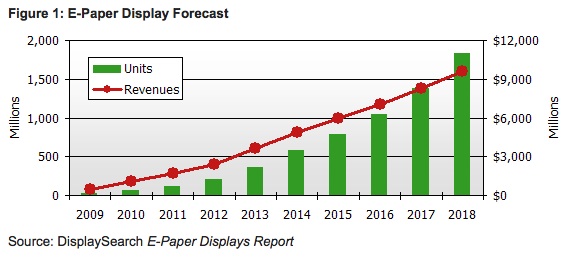
“E-paper displays are taking off with consumers due to their low power consumption and ease of reading, especially in sunlight,” Jennifer Colegrove, DisplaySearch director of display technologies, said in a statement.
Colegrove said the popularity of “green” products is expected to give digital paper a sales boost. Consumers who cringe at throwing away newspapers and magazines can read articles guilt free on devices with e-paper, which sip less power than back-lighted LCD displays.
Video Interview showing some new ePaper devices:
As a result, annual sales of digital book readers are projected to zoom from 1 million units in 2008 to 77 million in 2018.
Because of their thin profile, electronic paper has been embedded in items other than readers too, including magazines, credit cards, store-shelf tags and even clothing.
27
Aug
Aug
The consumer electronic market is changing rapidly, key-players are changing their positions and trying to catch the consumer in their digital life. Mobile Phone Manufacturer and Computer Companies are getting closer and closer. The new niche of Netbooks already became a big boom, documented by my friend Sascha on NetbookNews.de (Netbooknews.com).
Since a few years computer manufacture offer notebooks and laptops with integrated 3G Sim cards sometimes in combination with data-plans by a mobile network provider. Netbooks are low-cost laptops optimised for surfing the Internet and performing other basic functions. Pioneered by Asustek with the hit Eee PC in 2007, netbooks have since been rolled out by other brands such as HP and Dell.
But also the smartphones become more and more powerful and merge into small “mini computers”. So the gap between a PC and a mobile phone is almost disappearing and the fight for this market between the industry leaders has started.
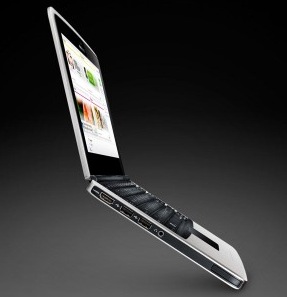 Nokia just annouced its first laptop computer, Nokia Booklet 3G.
Nokia’s Executive Vice President for Devices, Kai Oistamo, summed it up simply as follows:
“A growing number of people want the computing power of a PC with the full benefits of mobility. We are in the business of connecting people and the Nokia Booklet 3G is a natural evolution for us. Nokia has a long and rich heritage in mobility and with the outstanding battery life, premium design and all day, always on connectivity, we will create something quite compelling. In doing so we will make the personal computer more social, more helpful and more personal.”
Nokia’s first netbook will use Microsoft’s Windows software and Intel’s Atom processor to offer up to 12 hours of battery life while weighing 1.25 kilograms. Research firm IDC expects netbook shipments this year to grow more than 127 percent from 2008 to over 26 million units, outperforming the overall PC market that is expected to remain flat and a phone market which is shrinking some 10 percent.
“Nokia will be hoping that its brand and knowledge of cellular channels will play to its strengths as it addresses this crowded, cut-throat segment,” said Ben Wood, director of research at CCS Insight. “At present we see Nokia’s foray into the netbook market as a niche exercise in the context of its broader business.” Nokia’s choice of Windows software surprised some analysts who had expected the company to use Linux in its first laptop.
25
Aug
Aug
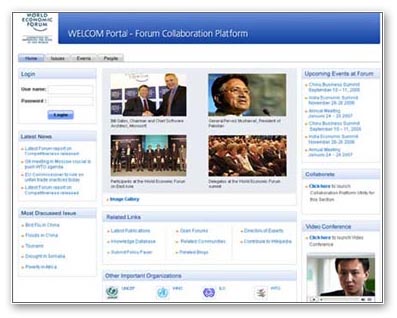
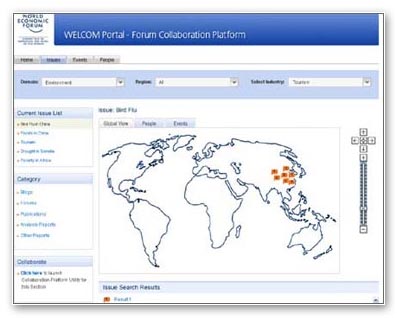
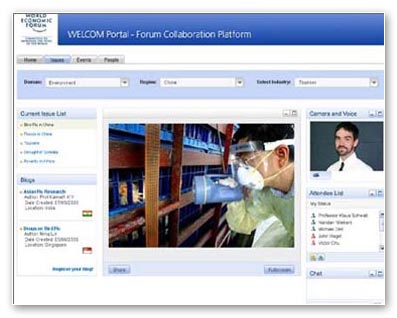
The World Economic Forum is developing the most exclusive online Social Network, called WELCOM. The name is an acronym for “The World Economic Leaders COMmunity”. The community will inhabit the top 10.000 world leaders, executives, managers, CEO, politicians, visionaries and movers and shakers. The social network will offer many collaboration and communication tools, such as contacts, groups, chat, mail, video call, file sharing etc. So many conversations will happen behind a big “digital security wall”.
Here are three Screenshots of the WEF WELCOM platform:
Description at the Website of the World Economic Forum (WEF):
WELCOM is a powerful new online communication and collaboration space designed specifically for the world’s top decision-makers. With a range of innovative tools for locating and accessing expertise, sharing knowledge, and meeting and working with peers, WELCOM empowers a multistakeholder approach to addressing the most pressing business and global governance challenges.
02
Jul
Jul
The Mobile Innovation Week 2009 is a combination of a grassroot developer event as well as an executive management event, called the Mobile Media World. In the following interview with Michael J. O’Farrell, he explains the concept and the basic idea behind this event.
Links:
wwww.mobileinnovationweek.com and www.mobilemediaworld.com.
01
Jul
Jul
I’m happy to “steal” this great presentation from Faris. It is a brilliant one about social media, full of interesting stories and examples.

Be Nice Or Leave
View more PDF documents from Faris Yakob.
01
Jul
Jul
I met Michael J. O’Farrel for an interview about the Status of the Mobile Internet in Toronto, Canada.
Michael is Chief Marketing Officer at Zameen Group and Vice Chairman of ooober; as well as a strategic advisor to mobigenics, Graham Sanborn Media and The Centre for Creative Communications at Centennial College. He is Chair of the dotMobi Advisory Group and co-author of the Wiley publication Mobile Internet for Dummies.
Michael is also Advirsor to the @mocom2020 Projekt:
http://www.mocom2020.com/authors-contributors/
30
Jun
Jun
I recently met Jim Gilmore during an Executive Management Workshop in Toronto, Canada, and talked with him about the Experience Economy and his fascinating management event “ThinkAbout”.
Experience Economy:
Goods and services are no longer enough. To be successful in today’s increasingly competitive environment companies must learn to stage experiences for each one of their individual customers. We have entered the Experience Economy, a new economic era in which all businesses must orchestrate memorable events for their customers that engage each one of them in an inherently personal way.
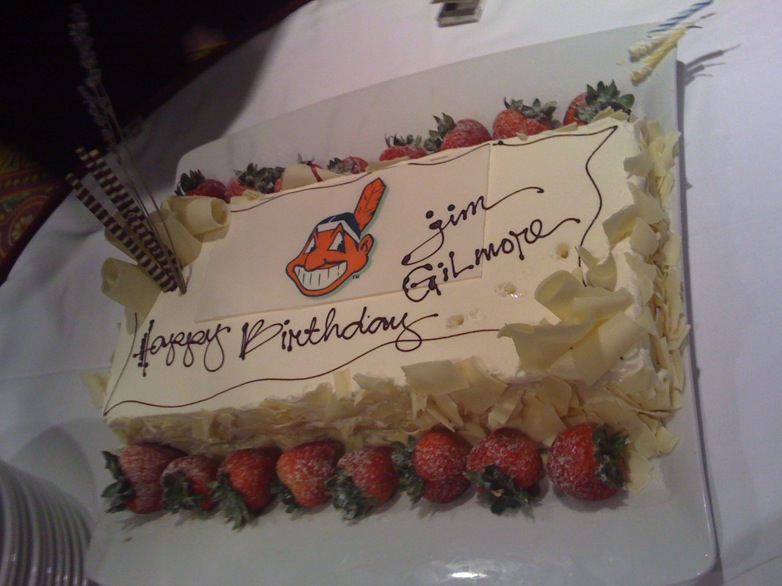
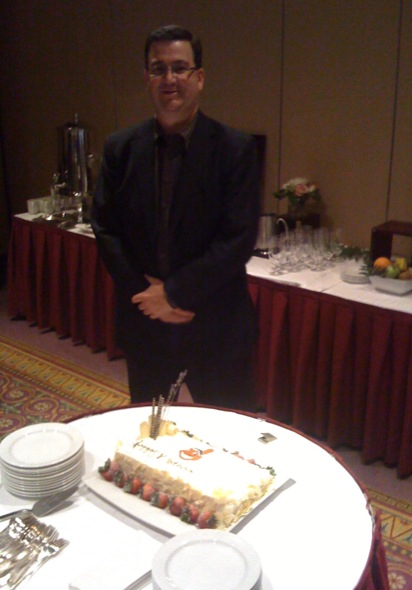
The workshop was actually on Jim’s birthday – so we had to celebrate this a bit.
Happy Birthday, Jim!
22
Jun
Jun
CNN report that the role of Twitter in the Iranian protests has got the attention of the Pentagon as well as Hilary Clinton.
Language


Digital Leaders
A global network of some of the smartest and influential people in the internet, mobile and tech-industry.
www.DigitalLeaders.co

www.DigitalLeaders.co